Automation is no longer optional; it’s a core enabler of faster releases, consistent quality, and cost efficiency. Yet, as tools and teams evolve, many companies find themselves stuck. According to the World Quality Report, 44% of organisations cite difficulties maintaining test automation due to changing requirements and a lack of skilled resources. We will take a look at how ESSA approach can be used to improve the maturity of test automation practices in an organization.
Key Trends in Test Automation
- CI/CD integration is standard, but automation must keep up with frequent deployments.
- AI-powered tools are rising, but strategy still lags behind technology.
- Test coverage is growing, yet many scripts fail to deliver real value.
Common Challenges
- Test suites bloated with low-value cases
- Flaky scripts that fail without valid reasons
- Lack of Alignment between QA, Dev, and business goals
- Over-engineered frameworks that collapse under pressure
We recently encountered one such project. The tools were in place, and the scripts were running. However, the results were unreliable, and no one trusted the tests. It wasn’t a test automation project—it was a rescue mission.
ESSA: The Principle That Fixes the Chaos
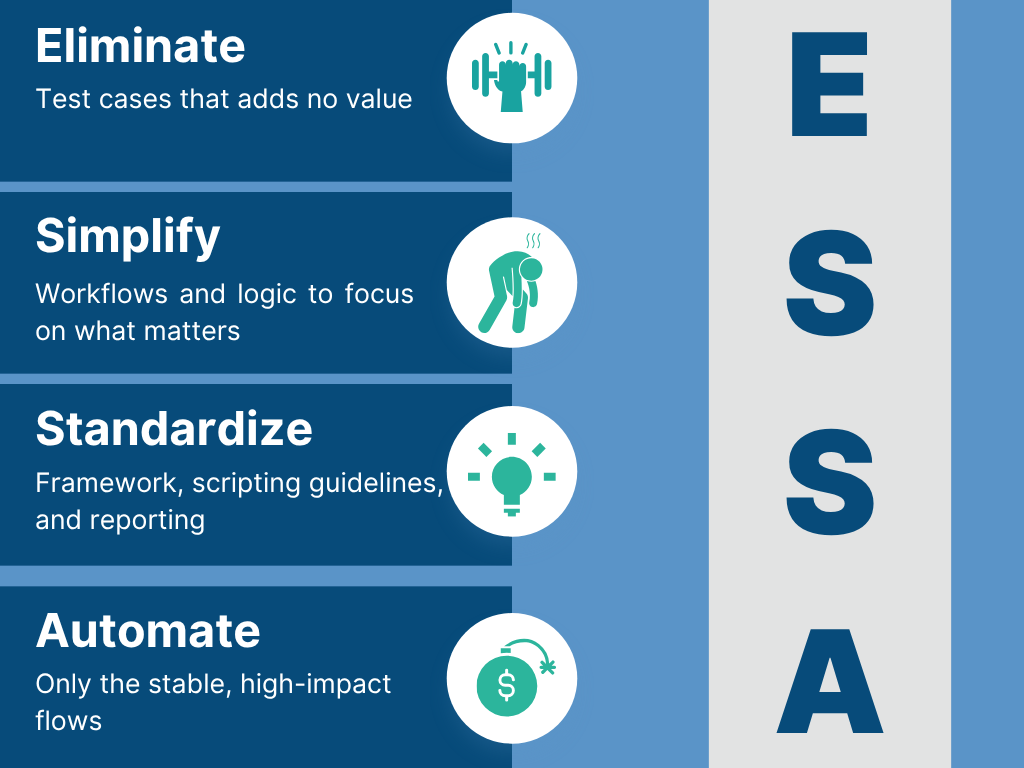
They had tools. They lacked thinking.
We introduced the ESSA Principle, and it flipped the project on its head. Here’s how it solves the most pressing challenges in automation:
1. Eliminate — Cut the Noise
Remove tests with no clear ROI. If a test doesn’t support a key business function or catch meaningful bugs, it’s technical debt.
2. Simplify — Make Tests Lean
Break down complex workflows. Simplify test logic to reduce flakiness and increase maintainability. Clear, modular scripts win every time.
3. Standardise — Create Alignment
Use consistent naming conventions, folder structures, and reporting formats. It improves collaboration and makes onboarding faster.
4. Automate — With Intention
Only automate after eliminating noise, simplifying logic, and standardizing workflows—Prioritise stable, high-impact flows.
The Result:
- 40% fewer scripts
- Less than 1% false failure rate
- High trust across QA, Dev, and Product
Building a Sustainable Automation Testing Methodology with ESSA
Step 1: Define Objectives
Clarify why you’re automating—faster feedback, improved regression coverage, reduced manual effort?
Step 2: Scope the Right Test Cases
Use risk-based selection: Automate high-impact, repeatable flows. Skip unstable or fast-changing features.
Step 3: Design a Modular Framework
Use proven design patterns like POM or data-driven testing. Modular frameworks reduce rework.
Step 4: Integrate into CI/CD
Run tests with every code change. Automation should serve as a quality gate.
Step 5: Monitor, Maintain, Improve
Use observability tools to track test performance. Retire or refactor failing scripts. Review your automation backlog quarterly.
Test Strategy in Automation: Where ESSA Fits In
A practical test strategy includes:
- Tools: Selenium, Playwright, Appium, etc.
- Frameworks: Hybrid, keyword-driven, BDD
- Execution: Parallel, cloud, container-based
- Data: Synthetic, masked, or production-like
- Reporting: Centralized dashboards, alerts, traceability
ESSA helps you make more intelligent choices within this strategy.
ESSA in Action: A Real Case Study
A large fintech company had over 1,200 automated scripts, yet test runs were unpredictable. Nearly 20% failed daily, and developers ignored test reports, slowing down releases.
Applying ESSA:
- 400 low-value scripts were removed
- Simplified test flows cut execution time by 30%
- A unified framework and naming improved readability
Impact:
- Faster triage, higher trust
- QA became a partner, not a blocker
- Release velocity improved with confidence
Keeping Your Test Automation Strategy Fresh
Tech evolves. Your test automation approach must, too. Review your strategy:
- Every 6 months
- During major feature launches
- When shifting tools, teams, or delivery models
ESSA is not a one-time fix. It’s a mindset to keep automation lean, meaningful, and maintainable.
FAQs: Test Automation and ESSA Approach
1. What is a test automation approach?
A test automation approach is a strategic framework for planning, building, executing, and maintaining automated tests that are aligned with business goals.
2. How does the ESSA principle apply to automation?
ESSA stands for Eliminate, Simplify, Standardise, Automate. It streamlines automation efforts and reduces failure rates.
3. What are the steps to building a sustainable automation strategy?
Define goals, select high-value cases, build modular frameworks, integrate with CI/CD, and review regularly.
4. What are the common mistakes in automation planning?
Automating everything, skipping test reviews, poor script maintenance, and ignoring QA-Dev collaboration.
5. Why is standardization important in test automation?
It improves consistency, onboarding, and test execution quality across teams and environments.
6. What is the ESSA approach?
The ESSA approach is a structured methodology in test automation focused on four actions: Eliminate, Simplify, Standardise, and Automate. It helps teams reduce waste and focus only on meaningful, high-impact automation.
7. What is ESSA in business?
In a business context, ESSA represents a disciplined approach to process improvement—removing inefficiencies, simplifying workflows, aligning teams, and automating only where it truly adds value.
8. What is the complete form of ESSA?
ESSA stands for Eliminate, Simplify, Standardise, Automate.
9. How can the ESSA approach eliminate redundancies and waste?
Start by identifying redundant test cases or overly complex scripts. Eliminate what doesn’t deliver value, simplify what’s too brittle, standardize your test assets, and only then automate. This structured ESSA approach cuts clutter and boosts reliability.
Conclusion: Test Automation Needs Thinking Before Tools
Automation fails without a strategy. ESSA gives teams a clear, repeatable way to make automation count—less noise, more value. It turns chaos into confidence.
Need help applying ESSA to your environment? Visit testmetry.com to learn more or connect with our QA experts.