For all of us living in a digitized world today, mobile apps or websites are the systems driving everything from shopping to communication. It has never been more important to efficiently get out high-quality software ready for use. For the software to meet the expected quality standard, testing is an essential part of the process. The implementation of a test management tool will make the testing process faster and more efficient. A test management tool helps team members work together, allows tracking tests in real-time and automates some of the tasks that are crucial and repetitive.
The true value of test management or any testing tool is unlocked only with a well thought of implementation plan. Without a clear strategy, even the most advanced tools will fail to deliver the anticipated results. Poor testing and a lower return on investment often follow as the result.
This article simplifies the process of implementing a test management tool into actionable steps. By following this approach, you can ensure that the tool is effective for your team, and consistently delivers long-term value.
Introduction to Test Management Tools
In the absence of any test management tool, the testing activities will become very cumbersome to manage and prone to errors. So many teams are using spreadsheets like Excel for storing test cases; they become very difficult to manage when the number of test cases grows. Bad version control practices will lead to the testers using wrong versions of the test cases during execution. This leads to inconsistencies and a lot of reworks.
Moreover, preparing audit or compliance documentation is very time-consuming because critical records may be placed in several different locations. Without a central management solution, reuse of test cases becomes limited, which involves spending a high amount of time and effort in designing the tests every time there is a release or enhancement project.
In general, such an approach affects tester productivity and causes a higher risk of errors, leading to low-quality testing. With the new adoption of Agile and DevOps, where speed and efficiency are essential, manual test management practices have become a significant issue. This is where test management tools come into play, facilitating collaboration and tracking.
Key Benefits of a Test Management Tool
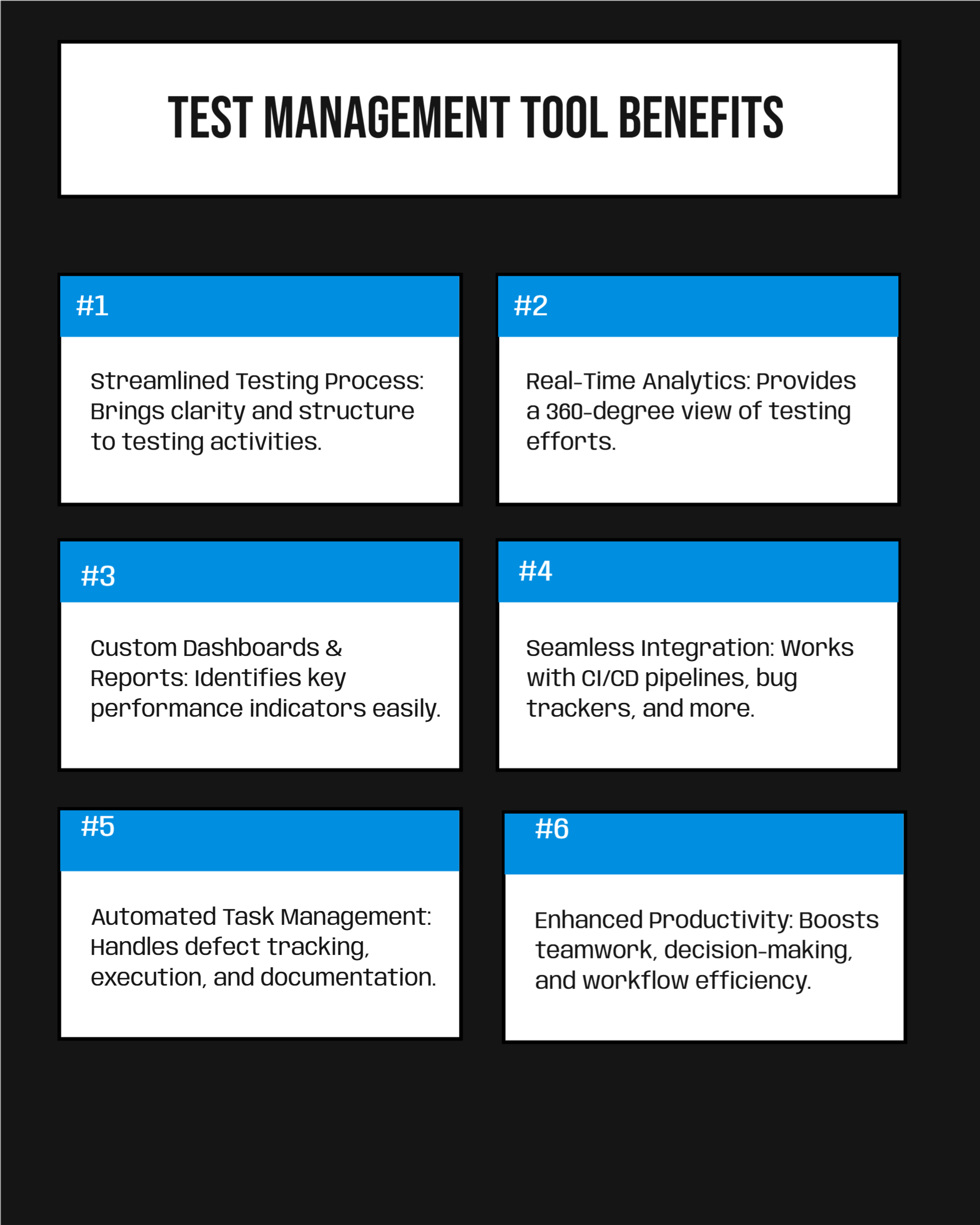
Test management tools transform the testing process from a complex and often chaotic process to one of clarity and cohesion. They weave together the necessary elements of user stories, test cases, outcomes and defects to form a cohesive story that allows the teams to be able to navigate and document the testing activities from start to finish. Real time analytics and comprehensive summaries of both manual and automated tests are some of the capabilities that these tools provide for the purpose of giving the user a 360-degree view of the testing efforts.
Customizable dashboards and detailed reports assist in identifying key performance indicators, thus enabling the teams to focus on critical aspects without being bogged down in unnecessary information. This is because version control is just a walk in the park when it comes to updating test cases and scripts, while at the same time, keeping a record of all the changes that have been made. These tools do not operate in a vacuum; rather, they operate in conjunction with lifecycle management systems, CI/CD pipelines, and bug trackers to create an end-to-end workflow without any gaps or unnecessary steps.
When it comes to the nitty gritties, test management tools find time to do the menial jobs like defect tracking, test execution and documentation of the results, this leaves the team member enough time to worry about the important issues. They also work for resource planning, asset management, onboarding, and the day-to-day running of the testing activities, all this with no fuss. These tools are not just useful assets, but also productive ones. They enhance productivity, teamwork, decision making, and handling of increasing workloads. At the level of development and testing, they serve as standard components of modern workflows, influencing the creation of software product quality.
A Dynamic Approach for Implementing a Test Management Tool
When picking a test management tool, it is crucial to develop a plan that will ensure that the tool picked meets the organization’s needs and will continue to be useful in the long run. The method of Discovering and then Igniting and Elevating provides a process that is easily integrated and amounts to lasting achievements.
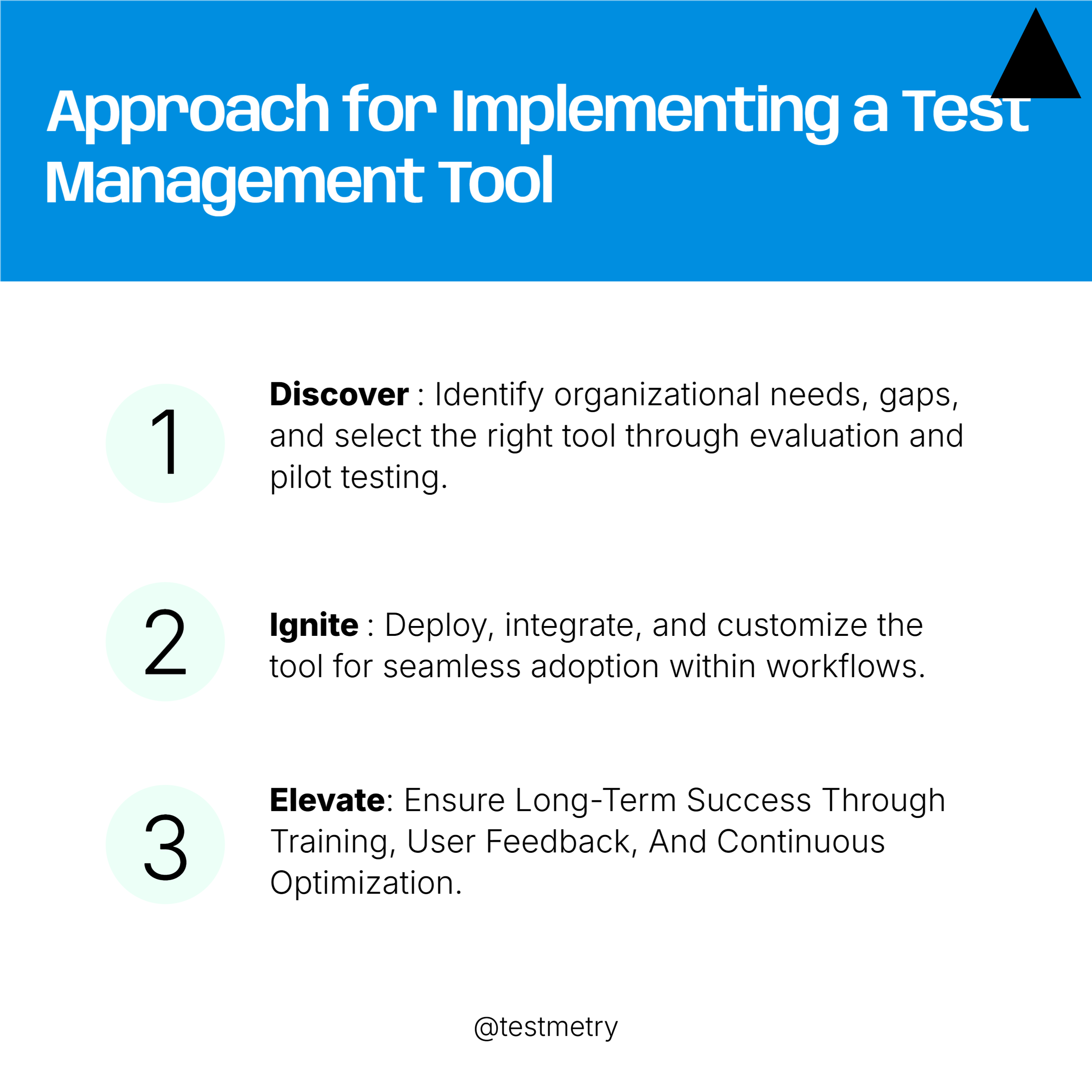
In the Discover phase of the process, we first seek to understand the challenges and objectives of your organization through the assessment of the tools already in use, identification of areas where things can be improved or where changes can be made to meet the needs of your organization. This phase includes testing the solution through a Proof of Concept (POC) or trial to make sure it meets all the required standards and expectations.
The Ignite phase is where the tool is brought to life. It’s about installing it, connecting it to your existing systems, and customizing it to fit how you work. You’ll also adjust the settings to match your needs, create clear user guides, and run test projects to check everything works smoothly. The goal here is to set things up in a way that encourages the right use of the tool from the start.
In the final phase, Elevate, the goal is to help users get comfortable with the tool and use it effectively. This means providing practical training, listening to their feedback to see what’s working and what’s not, and being there to support them so they feel confident using it in their daily work.
Discover Phase: Setting the Foundation
It is important to build up the proper foundation when it comes to implementing a test management tool. First of all it is worthwhile verifying the goals of the organization with respect to testing. Determine specifically what areas you are trying to improve, such as cutting down on time through automation rather than manual processes, being able to better track the progress of tests or improving communication between team members.
This is because with a set of clearly defined goals, it is easy to determine which tool will be effective in addressing these goals. In the next step, take an inventory of the current tools to determine what each does well and where they are lacking. The lack of automation, poor reporting or limited scalability of tools that exist can all be factors to consider. This will help identify gaps in the new tool and ensure it is better than the previous one in some way.
It is also important to plan for future testing needs. In light of this it is important to determine whether or not there are likely to be changes in the volume of work or the complexity of integration that will be required and to ensure that the tool chosen can handle these changes. Other factors to consider when evaluating tools include user-friendliness, integration, configuration, cost and availability of support. The tool should also be tested through Proof of Concept (POC) to assist in identifying features of the tool and to get input from stakeholders before making a selection.
So as not to cause any difficulties it is recommended to begin with a small representative sample of the workflow that will be extended to the entire organization. Ensure that you have enough resources, verify that the infrastructure is ready for use and establish what objectives you want to use to evaluate the tool in a real-life scenario. This approach helps to minimize risks and in turn provides the necessary foundation for a successful rollout to the entire organization.
Ignite Phase: Deploying the Tool
The Ignite phase begins with acquiring and configuring the test management tool to guarantee that it can be easily integrated within the organization’s environment. When installing the tool on-premises, it is deployed within the company’s existing infrastructure; conversely, when using a SaaS model, the tool is configured to meet the organization’s needs. Regardless of the method of deployment, the setup is thoroughly tested against the needs that were identified in the analysis phase. This is to ensure that the tool is compatible with other systems as well as to minimize the risk of any operational interruptions.
The above tool is also trialed through pilot projects after it is deployed to its production environment. The pilot projects are used in determining whether the tool meets the predetermined objectives and whether the users of the tool are able to use it easily. The outcome of the pilot is presented to the stakeholders to get their seal of approval and to give them assurance that the tool is useful. When the tool is available, attention turns to how best to tailor it to the organization’s culture and working style.
This may require altering the workflows to reflect how the organization runs. One can also define user roles, create test case templates, and customize dashboards to report testing activities. To make the process easier for users to go on-board, detailed documentation is created. Such documentation includes user guides, quick-start guides, and FAQs, all of which are designed to reduce the amount of time it takes to learn the tool, and to make the testers comfortable using it.
The reporting and version control features are also activated to monitor aspects like test coverage, defect life cycle, and test run coverage. These measures will help in ensuring that there is transparency and accountability in the testing process and in meeting the required testing and regulatory standards, thus providing a good base for efficient and effective test management.
Elevate Phase: Driving Adoption and Sustaining Success
The Elevate phase is the process of entering the tool into the organizational culture and processes so that the tool is properly incorporated into the daily operations. Such onboarding of other teams like Development, QA and DevOps should be done in such a way that configurations are tailored to their needs. It should be rolled out departmentally in a gradual manner to aid adoption and limit disruption. This phase is also characterized by training sessions and workshops at the level of users on how to use the tool in detail. This ensures that the learning is targeted on role and that cooperation, and the morale of the team members are enhanced through knowledge sharing.
Over time, it’s essential to evaluate how the tool is being used by different teams. This helps determine whether all its features are being fully utilized or if certain functionalities are underused or less effective. Regular feedback from users plays a key role in improving the tool, as it allows you to identify pain points and make necessary adjustments to its configuration to address evolving needs.
Establishing a reliable support system is equally important to provide users with technical assistance when needed. Additionally, the tool should be updated regularly to ensure compatibility with new technologies. Performance reviews can help identify areas for optimization, confirm whether the tool is being implemented effectively, and ensure it aligns with the organization’s goals. By doing this, the tool can grow alongside the organization and continue to deliver value in the long term.
Key Takeaways
This methodology outlines three levels in the process: Discover, Ignite, and Elevate. In the Discover level, the organization prepares the way by determining what their requirements are, what gaps exist, and picking the right tool for the job based on thorough evaluation and pilot testing that has been done. The Ignite level consists of bringing the tool to life in a seamless way, customizing it to fit the workflow, and to get the teams ready to fully accept it.
The last level, Elevate, is where the tool is made a part of the organization’s system and internal controls and is fine-tuned periodically to guarantee continued effectiveness. When this comprehensive approach is followed, then the organization is not only able to address the present problems but is also able to be able to modify the tool as it sees fit to meet its changing needs.
This process turns the test management tool into an essential part of the quality assurance toolkit, helping the testing team create better software faster while fostering greater confidence, stronger collaboration, and improved efficiency.Contact One Path today to streamline your test management tool implementation and unlock its full potential for your organization.
FAQs: Strategy for Implementing a Test Management Tool
1. How to choose the right test management tool for my organization?
First, it is recommended to determine what testing challenges and goals are for the organization. Then compare the tools based on the criteria such as ease of use, integration capabilities, scalability, customization options, and cost. This is where you should do a Proof of Concept (POC) to take a few tools of your choice and just try them out in real world scenarios and get people’s feedback before deciding.
2. What are the key benefits of using a test management tool?
Test management tools help with the workflow, they help in collecting and working in a team and they give a good picture of what has been done. They assist in ensuring that there is a cause and effect between a user story, a test case, and a defect, and assist in the scalability of the project for future projects and supports compliance with audit ready documentation and version control.
3. What is the Discover phase in the implementation strategy?
The Discover phase is the first step and the foundation of the process that is intended to establish the organization’s needs, identify the gaps in the current processes, and predict future requirements. This phase includes identifying objectives, evaluating tools, conducting POC, and recommending a pilot project to ensure that the tool selected meets the organization’s goals.
4. How does the Ignite phase guarantee successful deployment?
The Ignite phase involves acquiring the tool, placing it in your environment whether that is on-premises or SaaS and making sure it fits your processes. This phase also includes a pilot to test the tool, its features and how well it integrates with other systems and to create user manuals that will be easy to use.
5. What is the purpose of the Elevate phase?
The Elevate phase is the final stage where the tool is engulfed in the organization’s culture. It focuses on inviting other teams to use the tool, providing training and workshops, tracking the use of the tool and gathering feedback for improvement. This phase ensures continued effectiveness by promoting the use of the tool and fine tuning the processes as time goes by.
6. How can I ensure that the tool meets our compliance and regulatory needs?
Test management tools assist in meeting the standards of compliance through features like the ability to reverse and forward traverse tests, control versions of test artifacts, and produce audit ready reports. These capabilities assist in maintaining a clear record and ensuring that the organization is following the regulations that are in force.
7. Why do we need a phased approach to implementing a test management tool?
A phased approach is efficient because it deals with the organization’s needs in the following order: identifying requirements (Discover), selecting and developing the tool (Ignite), and integrating the tool into the organization (Elevate). This approach minimizes risks, ensures that all stakeholders are involved, and leads to the desired outcomes in the long run.