Why a playwright book matters
Automation frameworks evolve quickly. A quality playwright book not only teaches API usage but also captures best practices, debugging techniques, performance considerations, and integration strategies with CI/CD, TypeScript, and testing frameworks like Jest or Mocha. The right book saves you time by showing tried-and-tested workflows and explaining the “why” behind design decisions—this is especially important for Playwright since it offers multi-browser automation, powerful selectors, and network interception features that are different from older tools.
How I chose these top 5 books
Selection criteria included accuracy with the current Playwright API, usefulness of examples, coverage of modern testing needs (parallelization, CI, cross-browser testing), clarity of explanations, and practical, real-world problem solving. I prioritized books that are approachable for newcomers while still offering depth for advanced users. Each recommended title below has a brief summary, target audience, standout chapters, and how it fits into a learning path.
-
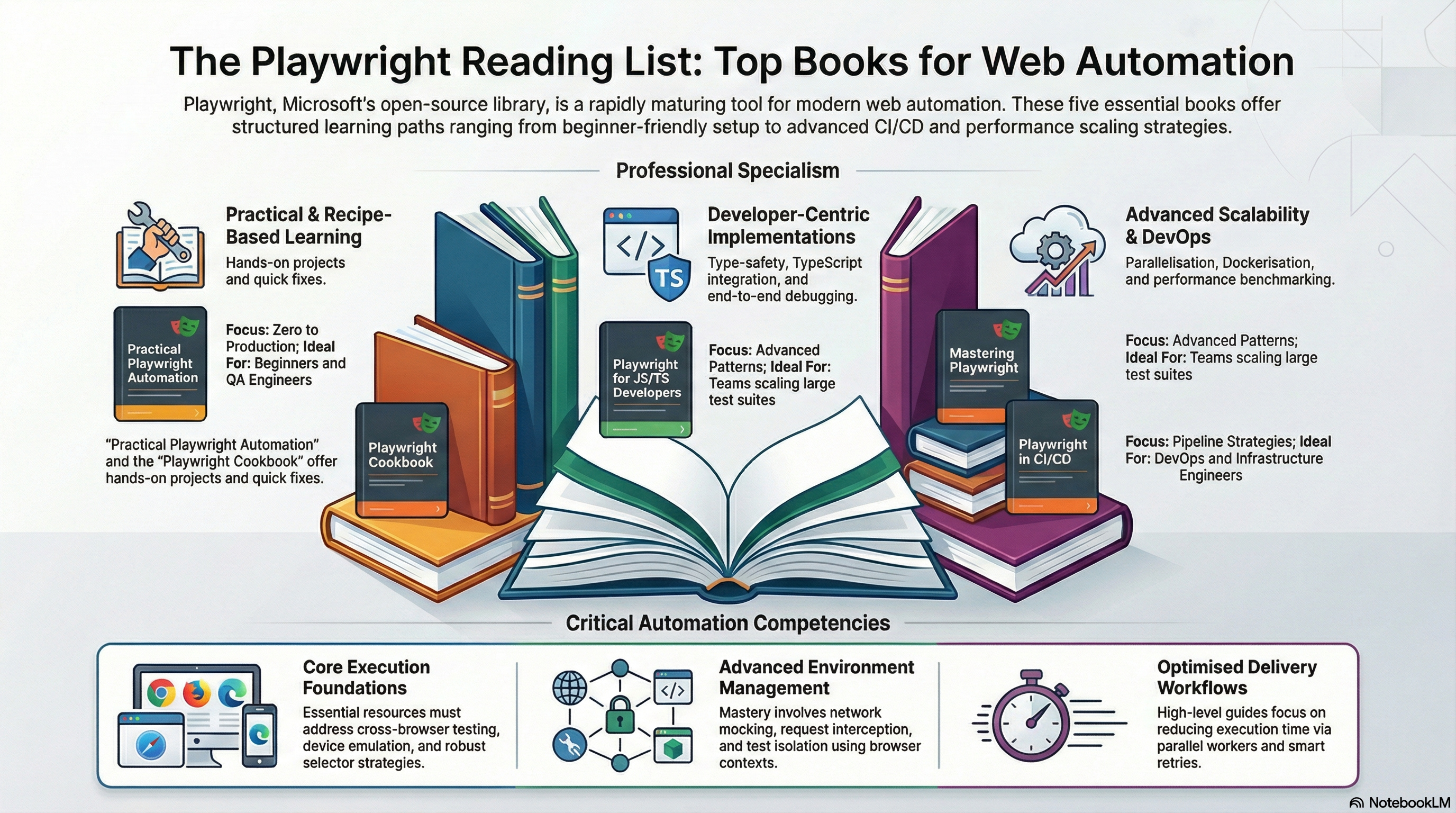
Practical Playwright Automation: From Zero to Production
This playwright book is a hands-on guide designed to take complete beginners to production-ready test suites. It starts with installation and basic scripting, then quickly moves to TypeScript integration, fixtures, and test organization. The strength of this book is its pragmatic focus: it includes several real-world projects such as testing a single-page application, e2e flows with authentication, and handling flaky tests.
Standout chapters: Test architecture and folder structure, network mocking and request interception, and CI pipeline examples (GitHub Actions and GitLab). Ideal for: Developers and QA engineers starting with Playwright who want a single resource that covers both fundamentals and production concerns.
-
Mastering Playwright: Advanced Patterns and Performance
Targeted at experienced automation engineers, this playwright book dives into advanced topics like performance testing with Playwright, parallelization strategies, browser context optimization, and sophisticated selector strategies. It emphasizes maintainability and scalability how to manage large test suites, reduce flakiness, and reliably run tests on multiple browsers and devices.
Standout chapters: Scaling test runs across worker nodes, reducing test execution time with smart retries, and benchmarking UI interactions. Ideal for: Teams operating extensive automation suites who need to optimize speed, reliability, and resource utilization.
-
Playwright for JavaScript and TypeScript Developers
This title focuses on integrating Playwright into the modern JavaScript and TypeScript ecosystem. It provides in-depth guidance on TypeScript typings, using Playwright Test, writing robust selectors, and leveraging Playwright’s powerful API features like route handlers and frame handling. The book also covers tooling such as ESLint, Prettier, and TypeScript compiler options tailored for test codebases.
Standout chapters: Type-safe tests with TypeScript, custom fixtures and plugins, and end-to-end debugging workflows. Ideal for: Developers who write tests in JavaScript/TypeScript and want a polished, type-safe implementation approach.
-
Playwright Cookbook: Recipes for Everyday Automation
Cookbook-style books are great when you want quick answers to specific problems. This playwright book is organized as concise recipes: logging into apps, filling complex forms, handling file uploads and downloads, taking reliable screenshots, dealing with modals and iframes, and testing WebSocket interactions. Each recipe is short, focused, and reproducible, making the book a handy desk reference.
Standout chapters: Handling flaky elements, visual regression testing recipes, and mocking third-party APIs. Ideal for: Practitioners who prefer a problem-solution approach and often search for targeted examples rather than long conceptual chapters.
-
Playwright in CI/CD: Continuous Testing Strategies
This specialized playwright book concentrates on integrating Playwright tests into continuous integration and delivery pipelines. It covers containerized test execution (Docker), running tests in cloud grids or self-hosted runners, managing secrets securely for authenticated tests, and implementing actionable test reporting and failure triage. The author also includes guidance for running Playwright tests alongside unit and integration tests, and how to gate deployments using reliable e2e checks.
Standout chapters: Dockerizing Playwright tests, flaky test detection and quarantine strategies, and integrating Playwright with feature flags and Canary releases. Ideal for: DevOps engineers and teams responsible for delivering test automation as part of CI/CD workflows.
How to get the most from a playwright book
Reading alone won’t build skills; practice is essential. Here are pragmatic steps to maximize value from any playwright book you choose:
- Follow along with the examples in a small sample project. Recreate scenarios rather than only reading code snippets.
- Adapt recipes to your application: if the book tests a demo app, implement the same flows against your own app to understand app-specific challenges.
- Combine resources: a cookbook plus a CI-focused book provides both quick fixes and deployment maturity strategies.
- Contribute examples back to the community your real-world adaptations might fill gaps in the book and help others.
Common topics a playwright book should cover
Whether you pick one of the recommended titles or another, make sure the book addresses these essential areas:
- Cross-browser testing and device emulation
- Reliable selectors and waiting strategies
- Network interception and mocking
- Test isolation with browser contexts and fixtures
- Debugging workflows, traces, and screenshots
- Scaling tests in CI, parallel workers, and containerization
Choosing the right book for your team
Match the book to your immediate needs. If you need to get started quickly, pick a practical or cookbook-style playwright book. If your priority is scaling and reliability, choose an advanced or CI-focused title. For teams standardized on TypeScript, pick a TypeScript-centric book to reap benefits from type safety and tooling alignment.
Final thoughts
A great playwright book does more than document APIs; it guides you toward robust, maintainable automation that integrates well with your development and delivery pipelines. The five books above cover a spectrum from beginner-friendly step-by-step guides to advanced scaling and CI strategies. Use them as complementary resources: start with a practical guide, keep a cookbook handy for quick fixes, and adopt advanced and CI-focused books as your automation efforts grow. If you invest the time to read, practice, and adapt patterns to your context, you’ll find Playwright a powerful tool for reliable, fast browser automation.
Frequently Asked Questions about Playwright Books
What is a Playwright book?
A Playwright book is a guide or textbook focused on Playwright, the end-to-end testing and automation framework, or on writing plays and playwriting techniques. In context of software testing it covers installation, APIs, test patterns, and practical examples; in theatrical context it covers structure, dialogue, character development, and stagecraft.
Which Playwright book is best for beginners?
For software testers, look for introductory books titled with “Getting Started with Playwright” or “Learning Playwright” that include setup, basic selectors, and simple test examples. For aspiring dramatists, choose beginner playwriting books that explain dramatic structure, character arcs, and scene writing with exercises.
Are there books that cover Playwright with TypeScript or JavaScript?
Yes. Many modern Playwright books include JavaScript and TypeScript examples, showing how to write tests, configure projects, and use Playwright Test runner with both languages. Check the table of contents or sample chapters to confirm language coverage.
How do I choose between a Playwright book and online documentation?
Official documentation is excellent for up-to-date API references and quick examples. Books provide structured learning, worked projects, patterns, and deeper explanations. Use documentation for reference and a book for a guided learning path and broader context.
What topics should a comprehensive Playwright book include?
Look for chapters on installation and setup, selectors and locators, actions and assertions, Playwright Test features, parallelization and CI integration, debugging, advanced browser contexts, cross-browser testing, network mocking, and performance considerations.
Are there Playwright books focused on advanced topics?
Yes. Advanced books or sections cover topics like custom test runners, test architecture, scaling tests, advanced debugging, browser internals, writing robust flaky-test strategies, and integrating Playwright into complex CI/CD pipelines.
Do Playwright books cover mobile and cross-browser testing?
Many books include chapters on cross-browser testing (Chromium, Firefox, WebKit) and how to emulate mobile devices or use real-device cloud providers. Verify the book mentions device emulation, viewport management, and platform-specific considerations.
Can I learn Playwright from short ebooks or cheat sheets?
Yes. Cheat sheets and short ebooks are useful for quick reference and common commands. They complement a full book or documentation but usually lack deep explanations and best practices.
Are there recommended companion resources with Playwright books?
Good companion resources include sample repositories on GitHub, official Playwright docs, community blogs, video tutorials, and Q&A forums. Many authors publish example code and updates online.
How often do Playwright books become outdated?
Playwright evolves regularly, so books can get outdated as APIs and best practices change. Prefer recent publications (within the last 1–2 years) and authors who maintain online errata or updated editions.
Should I buy a physical Playwright book or an ebook?
Choose based on preference. Ebooks are searchable and often include links to live code; physical books are useful for note-taking and offline reading. Ensure the format you choose comes with access to updated code samples.
Where can I buy reputable Playwright books?
Reputable sources include major bookstores and platforms (Amazon, O’Reilly, Packt, Manning) and publisher websites. Also check community recommendations, reviews, and the book’s GitHub repository for sample code.
When searching for resources, remember the keyword “playwright book” to discover the latest editions, community-written guides, and updated references that track Playwright’s fast-paced development. Happy testing—and may your suites be fast, stable, and easy to maintain.