You passed every technical screen. You know your testing frameworks. You can talk about shift-left in your sleep. Then the interview starts, and the panel asks about stakeholder management, and you give the answer that sounds right but doesn’t land. That’s the gap most QA engineers miss when they go for lead roles. The technical bar matters less than you think. The leadership and decision-making bar matters more than you’re prepared for. This post breaks down the QA lead interview questions you’ll actually face, what most candidates say, and what strong candidates say instead.
What Makes QA Lead Interview Questions Different From Regular Testing Interviews?
Most QA engineers prepare for interviews the same way they always have. They review test case design, brush up on automation frameworks, and rehearse a few STAR answers.
That’s not wrong. But QA lead interviews are testing something else entirely. Panels want to see how you think about trade-offs, how you handle conflict, and whether you can hold a quality position under pressure from product or engineering.
According to the 2024 World Quality Report, organizations now rank quality ownership and cross-functional collaboration as their top two challenges in scaling QA teams. Panels hire for those gaps directly.
That means the questions you’ll face are designed to surface how you operate at the intersection of testing, people, and delivery pressure. Technical competence is assumed. What’s being evaluated is your judgment.
Which QA Lead Interview Questions Trip Up the Most Candidates?
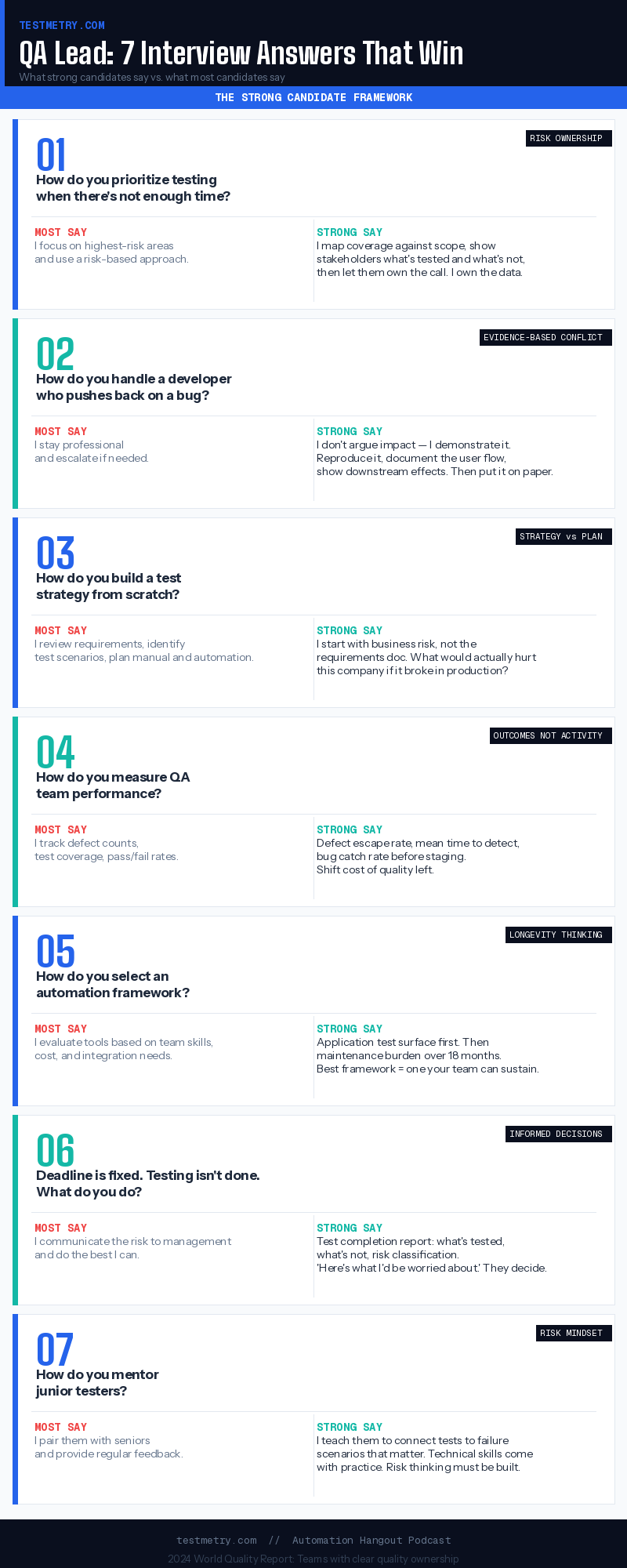
Seven questions come up in almost every QA lead interview. Here’s what most candidates say, and what hiring teams actually want to hear.
1. How do you prioritize testing when there’s not enough time?
What most candidates say: “I focus on the highest-risk areas and use a risk-based approach.”
Technically correct. Completely forgettable. Every candidate says this.
What strong candidates say: “I map test coverage against the release scope and take that map to the team. I show them exactly what’s covered, what’s not, and the risk of shipping without it. Then we decide together. I own the data. They own the call.”
That answer signals three things at once: you quantify risk, you communicate it to non-QA stakeholders, and you know where your authority ends. That’s lead-level thinking.
2. How do you handle a developer who pushes back on a critical bug?
What most candidates say: “I stay professional and escalate if needed.”
Panels hear this answer ten times a day. It tells them nothing about how you actually behave.
What strong candidates say: “I don’t argue impact. I demonstrate it. I reproduce the bug clearly, document the user flow it breaks, and show what happens downstream. If we still disagree, I put the risk on paper and let the product owner make the call with full information.”
The difference is specificity. You’re not managing conflict with politeness. You’re managing it with evidence and documented accountability.
3. How do you build a test strategy from scratch?
What most candidates say: “I review requirements, identify test scenarios, and plan manual and automated testing.”
That’s a test plan. Not a strategy. Panels at the lead level know the difference.
What strong candidates say: “I start with the business risk, not the requirements doc. What would actually hurt this company if it broke in production? I work backwards from that to decide where automation earns its keep, where exploratory testing catches what scripts miss, and where we need specialist coverage like security or performance.”
If you want a deeper look at building a test automation strategy that stands up to real-world pressure, the playbook on Test Automation covers the business case end to end.
4. How do you measure QA team performance?
What most candidates say: “I track defect counts, test coverage, and pass/fail rates.”
These are output metrics. They tell you how busy your team was. They don’t tell you if quality actually improved.
What strong candidates say: “Defect escape rate, mean time to detect, and what percentage of bugs were caught before reaching staging. I also look at how often we’re blocking releases versus catching issues during development. The goal is shifting the cost of quality left, not counting bugs at the end.”
That answer shows you understand outcome metrics, not just activity metrics. That’s the distinction panels look for when hiring someone to own a QA function.
5. What’s your approach to automation framework selection?
What most candidates say: “I evaluate tools based on team skills, cost, and integration needs.”
Panels expect that answer from mid-level engineers. At the lead level, they want to see how you’d actually run that evaluation.
What strong candidates say: “I’d look at the application’s test surface first. A heavily API-driven product has different automation needs than a complex UI-heavy app. I’d also consider maintenance burden over the next 18 months. The best framework is the one your team can actually sustain, not the one that looks impressive in the selection meeting.”
LambdaTest’s research on the longevity of automation frameworks supports this. Teams that choose frameworks based on team capacity and application type see significantly lower maintenance costs than teams that select based solely on brand recognition. See how this plays out across different application types in
6. How do you handle a situation where the release deadline is fixed but testing isn’t done?
What most candidates say: “I’d communicate the risk to management and do the best we can with the time available.”
This is the “I’ll try my best” answer. It’s not wrong. It’s just not a lead answer.
What strong candidates say: “I’d produce a test completion report showing exactly what’s tested and what isn’t. I’d classify the untested areas by risk level and include a recommendation. Then I’d present it to the stakeholders. ‘Here’s what we know, here’s what we don’t know, here’s what I’d be worried about.’ The decision to ship is theirs. The responsibility to inform that decision is mine.”
7. How do you mentor junior testers?
What most candidates say: “I pair them with senior testers and provide regular feedback.”
What strong candidates say: “I teach them to think about risk, not just test cases. I’ll have a junior tester walk me through why they wrote a particular test. If they can’t connect it to a failure scenario that matters, we work on that together. Technical skills come with practice. Risk thinking has to be built deliberately.”
How Do You Prepare for QA Lead Interview Questions Without Sounding Rehearsed?
The candidates who land QA lead roles aren’t the ones with the most polished answers. They’re the ones who sound like they’ve actually been in these situations.
Three things separate them from average candidates. First, they use specific numbers. Not “we improved quality” but “we dropped defect escape rate by 40% in two sprints by moving API testing earlier.” Second, they acknowledge trade-offs. Every good QA decision involves giving something up. Strong candidates name what they gave up and why. Third, they show they know where their authority ends. Leads who try to control everything are a liability. Panels want someone who can inform decisions, not make all of them unilaterally.
According to the 2024 World Quality Report, teams with clearly defined quality ownership are 2.4x more likely to ship on schedule with acceptable defect rates. That stat is worth memorizing. Use it in an interview when you explain how you structure QA ownership in your team.
What Are the Most Common Mistakes Candidates Make in QA Lead Interviews?
The biggest mistake is staying in individual contributor mode. Candidates describe what they personally did instead of what they led. Every answer becomes “I tested this” instead of “my team needed to do this, here’s how I set that up.”
The second mistake is treating every question as a technical question. When a panel asks about stakeholder communication, they’re not looking for a process description. They want to see that you understand people’s incentives and can work with them rather than around them.
The third mistake is not knowing your own metrics. If you’ve been doing QA for more than three years, you should be able to quote at least two quality metrics from your most recent role. Candidates who can’t signal that they weren’t paying attention to business outcomes. That’s a red flag for any leadership hire.
If you want a sharper look at how QA metrics connect to business outcomes, the post on Testing Metrics is a good place to start.
FAQ’s on QA Lead Interview Questions
1. What questions are asked in a QA lead interview?
QA lead interviews typically cover test strategy and planning, defect management, stakeholder communication, team mentoring, and how you handle delivery pressure. You’ll also face scenario-based questions about managing conflict between QA and development teams, prioritizing under time constraints, and making release recommendations with incomplete test coverage.
2. How do I prepare for a QA lead position?
Start by auditing your experience for examples where you made quality decisions under pressure. Document the metrics you used, the trade-offs you navigated, and the outcomes. Then practice framing those examples as leadership decisions rather than individual technical tasks. Panels evaluate judgment and ownership, not just technical knowledge.
3. What are the responsibilities of a QA lead?
A QA lead owns the test strategy for a product or team, mentors junior testers, defines quality standards, communicates risk to stakeholders, and makes prioritization decisions when time is short. They also typically manage the relationship between QA and development, bridging the gap between defect identification and resolution.
4. What is the difference between a QA lead and a QA manager?
A QA lead is primarily accountable for the quality of a specific product or project. They’re hands-on with test strategy and often still do technical work. A QA manager has broader responsibility across multiple teams or products, focuses more on team structure and hiring, and typically owns the QA budget and process standards across the organization.
5. How do you answer ‘tell me about yourself’ in a QA lead interview?
Anchor your answer in the scale and complexity of what you’ve led, not just where you’ve worked. Name the types of products you’ve tested, the size of teams you’ve worked with, and one specific quality outcome you’re proud of. Keep it under 90 seconds, and end with why you’re specifically ready for the lead role.
Conclusion on QA Lead Interview Questions
QA lead interview questions don’t reward the most technically prepared person in the room. They reward the person who can show they’ve already been thinking like a leader. Go back through the seven question types here and write a specific answer to each one, using real numbers and real situations from your own career.
If your answers feel thin, that’s useful information. It tells you where your experience has gaps versus where your ability to articulate experience is the problem. Both are fixable, but they require different work.
For more on the mindset shift that comes with moving into QA leadership, catch the Automation Hangout podcast, where we go deep on how experienced testers make the leap from doing to leading.