Quality assurance is not a phase, a job title, or a person who tests your software at the end. I’ve watched teams hire one QA engineer and expect that person to catch every defect a whole team created, and that setup fails every time.
The software testing market is projected to grow from $54.44 billion in 2026 to $99.94 billion by 2031, according to Mordor Intelligence, and most of that spend is chasing the same mistake: treating quality as a checkpoint instead of a process built into every step. Quality assurance is the process that makes testing necessary less often, not the department that does the testing.
This piece breaks down what QA actually covers, the four real types of QA, how QA differs from QC, and where automation fits without replacing the judgment call a person still has to make.
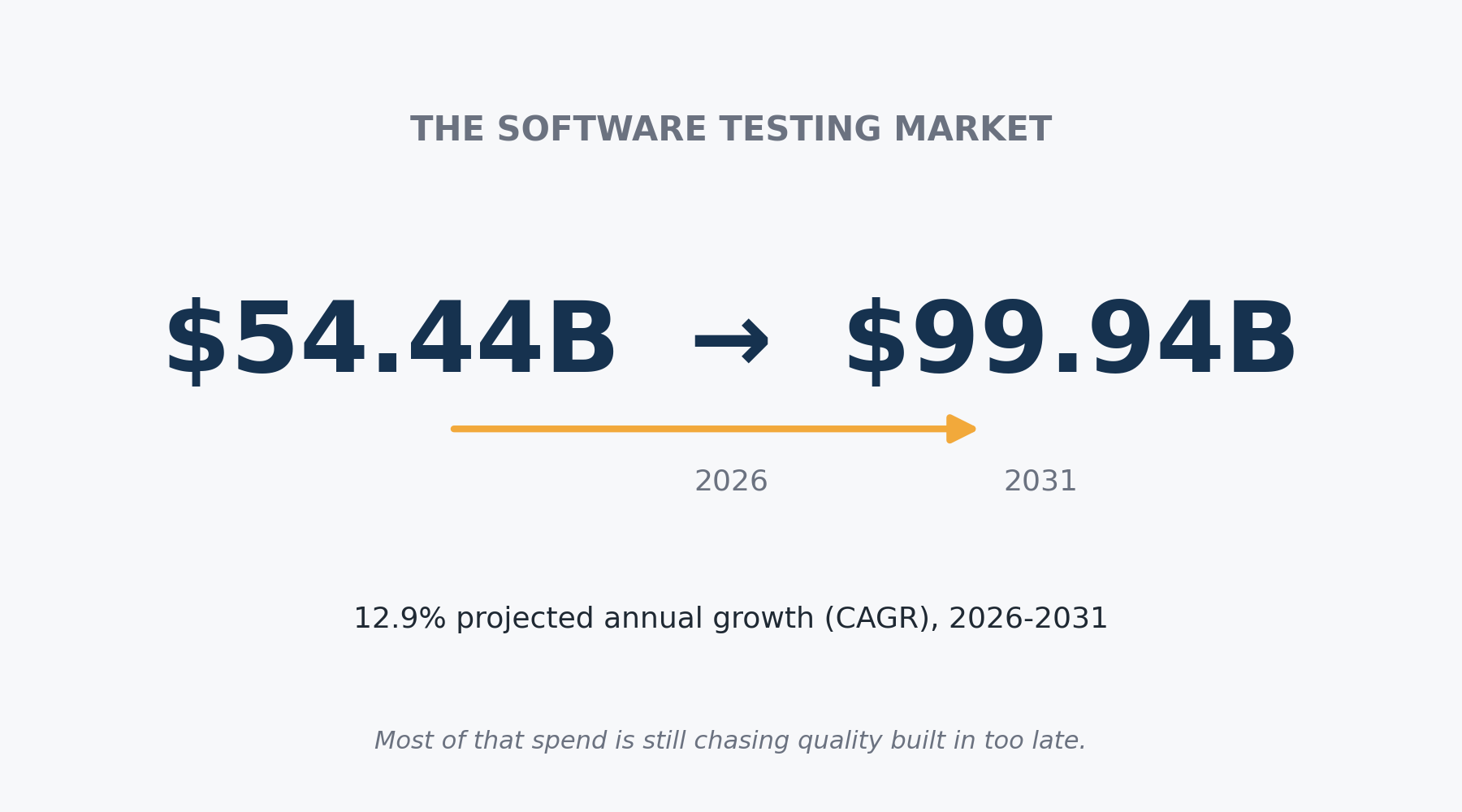
Source: Mordor Intelligence, Software Testing Market report.
Context
Most teams treat QA as the safety net at the end of a sprint, the team that catches what developers missed before a release. That assumption made sense when software shipped once a year and testing was one long phase before launch. It doesn’t hold up now that most teams ship weekly or daily and treat quality as something bolted onto the process instead of built into it.
Twenty-five years of watching QA programs succeed and fail have taught me the honest definition: quality assurance is the set of practices that make defects less likely to happen in the first place, not the people who find defects after they happen. That distinction sounds small. It changes who owns quality, how a team measures progress, and whether a QA hire actually fixes the problem a company thinks it’s solving.
Findings

Most teams only run the amber quadrants, detective and corrective, and call it done.
Quality Assurance Prevents Problems, It Doesn’t Just Catch Them
QA covers the checklists, audits, and process reviews that stop a defect before it exists, not the final check that finds one. A process checklist for a login feature might require a security review, a peer code review, and a defined set of edge cases before a story is called done, the same discipline behind real user acceptance testing.
Skip any one of those steps and the defect shows up later, more expensive to fix, further from the person who introduced it. The honest reason teams miss this: it’s easier to hire a tester to find bugs than to fix the process that keeps creating them.
The Four Types of QA Cover Different Moments, Not Different Teams
Preventive QA stops problems before they start: planning, risk analysis, and setting a clear definition of done. Detective QA finds problems after they happen but before a customer does: automated tests, peer reviews, audits. Corrective QA fixes the root cause once a real defect reaches production, not just the symptom, tracing a recurring login failure back to a config change instead of patching it every sprint.
Assessment QA checks whether the whole QA process is actually working: internal audits, benchmarking against how the team performed last quarter. Most teams only run detective QA and call it done, which is why the other three matter more than they get credit for.
QA and QC Are Not the Same Job, and Conflating Them Costs Teams Time
QA is about building the process right from the start. QC is about checking the finished product for mistakes. A team that calls its testers “QA” but only ever tests finished builds is running QC with a QA job title.
The distinction matters because QA work- definition of done, code review standards, risk planning- happens earlier and prevents more defects per hour spent than QC work does. Teams that invest only in QC end up finding the same category of bug release after release, because nothing upstream changed.
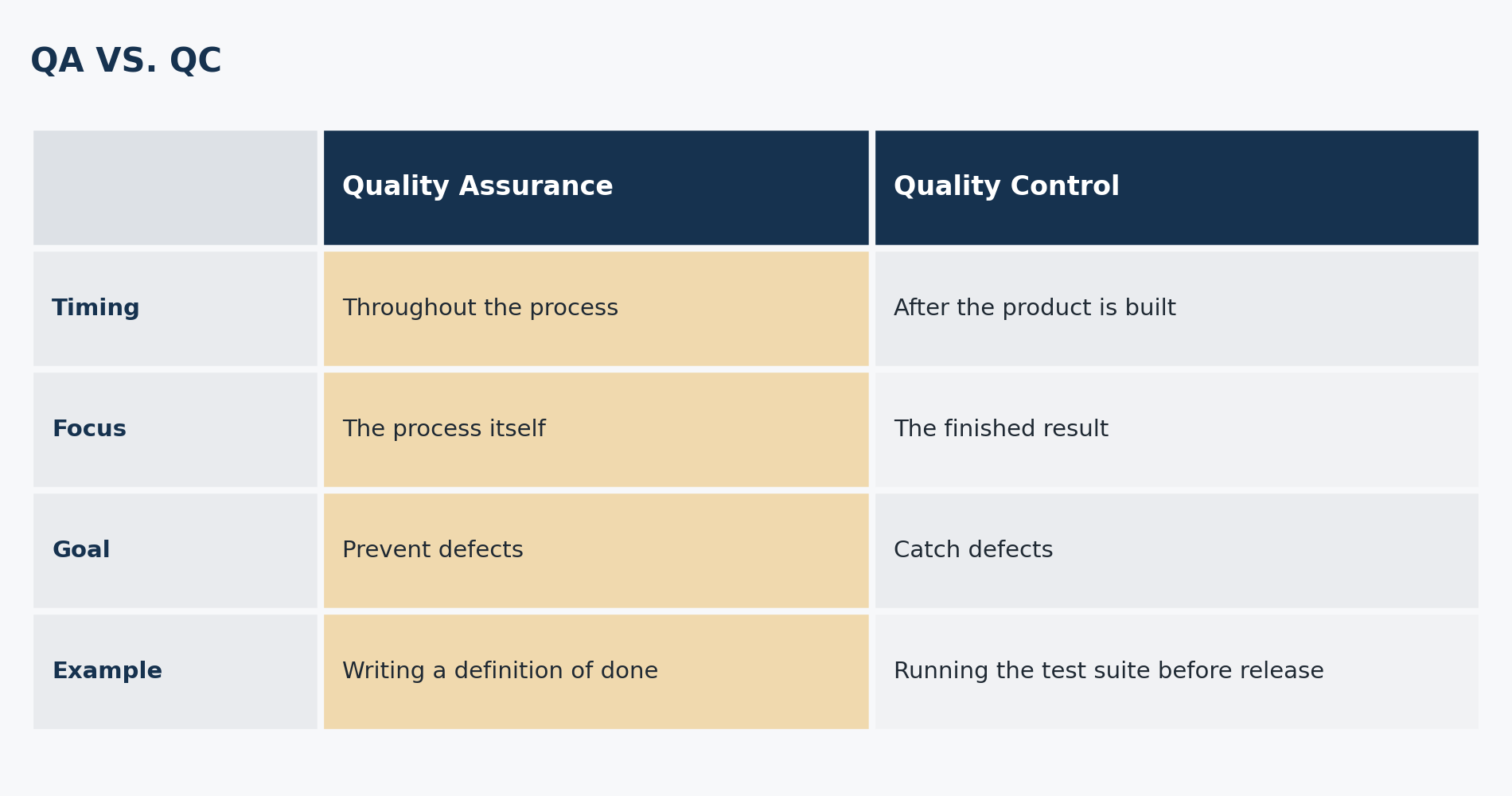
QA builds the process. QC checks the result.
Automation Extends QA’s Reach; It Doesn’t Replace the Judgment Part
Tools like Selenium, Cypress, and Playwright run the repetitive checks a person shouldn’t have to run by hand: does the button work, does the form submit, does the page load. That’s real time back, and it cuts the boring, repeat testing that burns people out.
What automation doesn’t do is decide which edge case matters to your specific product or judge whether a passing test actually reflects a good user experience. A suite that’s green across the board can still ship a feature nobody wants to use. Automation is a QA tool, not a QA strategy.

Field assessment from dashboards George has reviewed, not a published survey figure.
Most QA Metrics Teams Track Are Actually QC Metrics
Bug count, test coverage, and time to fix are the numbers most teams report on a QA dashboard, and all three measure output, not process. They tell you how many defects were caught, not whether the process that let those defects exist is improving.
A team serious about QA also tracks how often a definition of done gets skipped, how many defects trace back to a missed risk review, and how long a root cause investigation takes after a corrective fix. Track the process, not just the output, or the dashboard will look fine while the same mistakes repeat.
The Stuff That Doesn’t Work
Three assumptions about quality assurance don’t hold up once you’ve run a QA program for any real length of time.
“More test cases means better QA” doesn’t hold up. I’ve reviewed test suites with hundreds of cases that all tested the same happy path with slightly different data, and missed the one negative case that actually broke in production. Case count is not the same as risk coverage.
“QA is the last phase before release” doesn’t hold up either, and it’s the most expensive myth on this list. Every audit I’ve run points the same direction: a defect caught in planning costs a fraction of one caught after release. Treating QA as a phase instead of a practice guarantees you catch problems at the most expensive possible moment.
I used to believe QA was the QA team’s job alone, and that assumption cost my early programs real credibility. A developer who skips a code review standard is doing the job worse, not doing someone else’s job. Quality assurance works when the whole team owns the process, not when one department is held responsible for everyone else’s shortcuts.
How This Changes What You Do
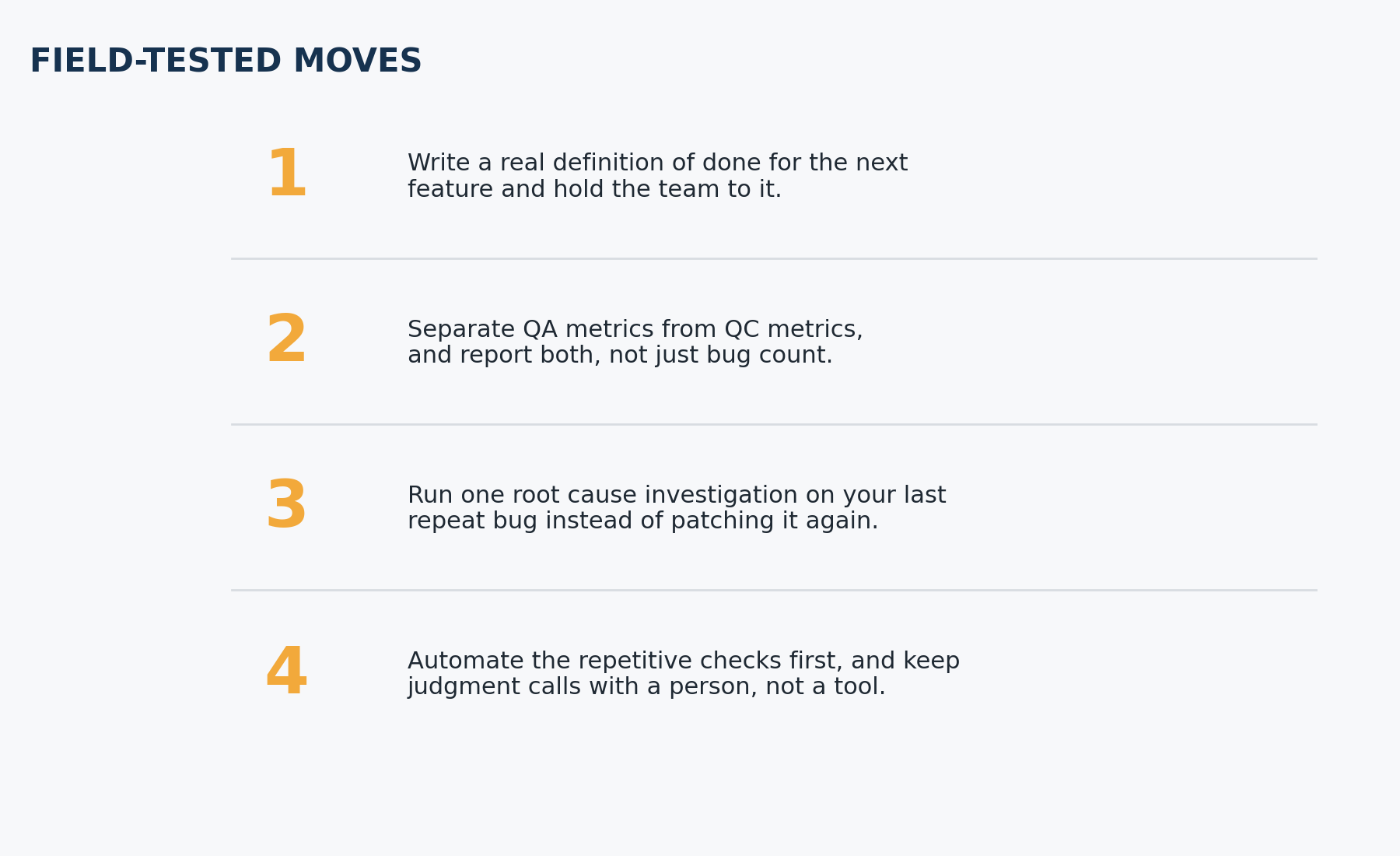
Four moves if your team’s QA program is more title than process right now.
- Write a real definition of done for the next feature and hold the team to it before calling anything complete.
- Separate your QA metrics from your QC metrics, and report both, so a clean bug count doesn’t hide a broken process.
- Run one root cause investigation on your last recurring bug instead of patching it again, and trace it back to the actual gap.
- Automate the repetitive checks first, and keep judgment calls, which edge case matters, whether the experience is actually good, with a person. See TestMetry’s piece on Copilot4DevOps for where AI fits into that same judgment call.
FAQ
What is the meaning of quality assurance?
Quality assurance means building a process that prevents defects instead of finding them after the fact. It focuses on how work gets done, planning, code review standards, risk analysis, so that fewer problems make it into a finished product. In practice, a team practicing real QA writes a definition of done and holds every feature to it before calling it complete.
What is the difference between QA and QC?
QA and QC differ in timing and focus, not in importance. QA happens throughout the process and aims to prevent defects, while QC happens at the end and aims to catch defects in a finished product. A team following a recipe correctly is doing QA. A team tasting the cake before serving it is doing QC.
What is the role of QA in a software team?
QA’s role is to build and maintain the process that keeps defects from happening in the first place. That includes setting a definition of done, running risk analysis before a feature starts, and reviewing whether the team’s methodology is actually working. QA also owns the audits that catch a weak process before it produces a weak product.
What are the 4 types of quality assurance?
The four types are preventive, detective, corrective, and assessment QA. Preventive QA stops problems before they start through planning and risk analysis. Detective QA finds problems after they happen but before a customer does, through testing and reviews. Corrective QA fixes the root cause of a real defect instead of just the symptom, and assessment QA checks whether the QA process itself is actually working.
Does QA mean testing?
No, QA includes testing but is not limited to it. Testing is one detective QA activity among several, alongside planning, risk analysis, code review, and process audits. A team that only tests finished software is running quality control, not the full scope of quality assurance.
What does someone in a QA role actually do day to day?
A QA engineer writes and reviews test plans, checks code and process against agreed standards, and investigates why defects happened rather than just logging them. Day to day work includes automated test maintenance, risk assessment on new features, and process audits that catch gaps before they turn into repeat bugs. The strongest QA engineers spend as much time on process as they do on test execution.
The Bigger Picture
Automation testing alone is projected to grow from $20.60 billion in 2025 to $84.22 billion by 2034, a 16.84 percent compound annual growth rate, according to Fortune Business Insights. That growth reflects a shift already underway: the boring, repeatable parts of QC are getting handed to tools, which frees actual QA capacity for the process work only a person can do: risk analysis, root cause investigation, definition of done conversations.
The teams that get this right won’t be the ones with the biggest automated test suite. They’ll be the ones who use automation to free up time for prevention instead of just running more checks faster. Quality assurance was always meant to be upstream work. Automation finally makes that possible at scale, if teams spend the time it saves on the right thing.
Closing
Quality assurance is the process, not the person, not the phase, not the department blamed when something breaks. Build the process right, and QC has less to catch. I built NoSkript around the same principle this whole piece rests on: quality gets built in early, or it gets paid for late.