I’ve watched automation testing services deliver ROI between 137% and 1,100% in year one depending on a single variable: whether the team architected their framework before implementation or built it as they went. The difference isn’t the tool, the vendor, or even the test cases. It’s whether someone made one deliberate decision about how the suite would be maintained.
Most teams that pick an automation testing service assume the real work is choosing the right vendor and writing the first test. That’s maybe 20% of what determines success. The other 80% is what happens in month two when the first refactor breaks 47 tests because the locators were hard-coded instead of centralized. When that happens, you’re not looking at a productivity gain anymore. You’re looking at 60-70% of your automation effort going to maintenance instead of new coverage. That’s where automation testing services stop delivering returns.
I’m going to show you what that trap looks like and how to spot it before your vendor onboarding even begins.
Context
The industry consensus is that automation testing services deliver cost savings and faster release cycles. That’s true, but it’s incomplete. What gets left out is the maintenance burden. Seventy-five percent of teams never achieve expected ROI from automation because they treat the tool selection as the hard part and architecture as something that sorts itself out.
I’ve spent 25 years watching this pattern repeat across Fortune 500 testing programs. A team hires an automation testing service, the vendor delivers working test scripts within weeks, and the team feels like they’ve won. Then month three hits. Production bugs slip through, regression cycles blow up, and the maintenance work starts swallowing resources. The team concludes automation testing doesn’t work for their context, when what actually happened is they made architecture decisions that guaranteed failure.
The real question isn’t whether automation testing services work. According to Ranorex , 88% of teams with well-architected suites report 20-40% productivity gains. The question is whether your team will architect properly before committing to a vendor.
Your Framework Architecture Determines ROI More Than Tool Choice (Not the Vendor)
Every automation testing service on the market uses similar tools. Selenium, Playwright, Appium. The differences are marginal. What determines whether you hit 137% ROI or crater to negative returns is one decision: object repository vs. hard-coded locators.
Well-architected automation testing services use centralized object repositories. When an element changes, you update one place. Brittle suites hard-code locators into test scripts. When an element changes, you fix 12 tests that all had the same locator buried in different places.
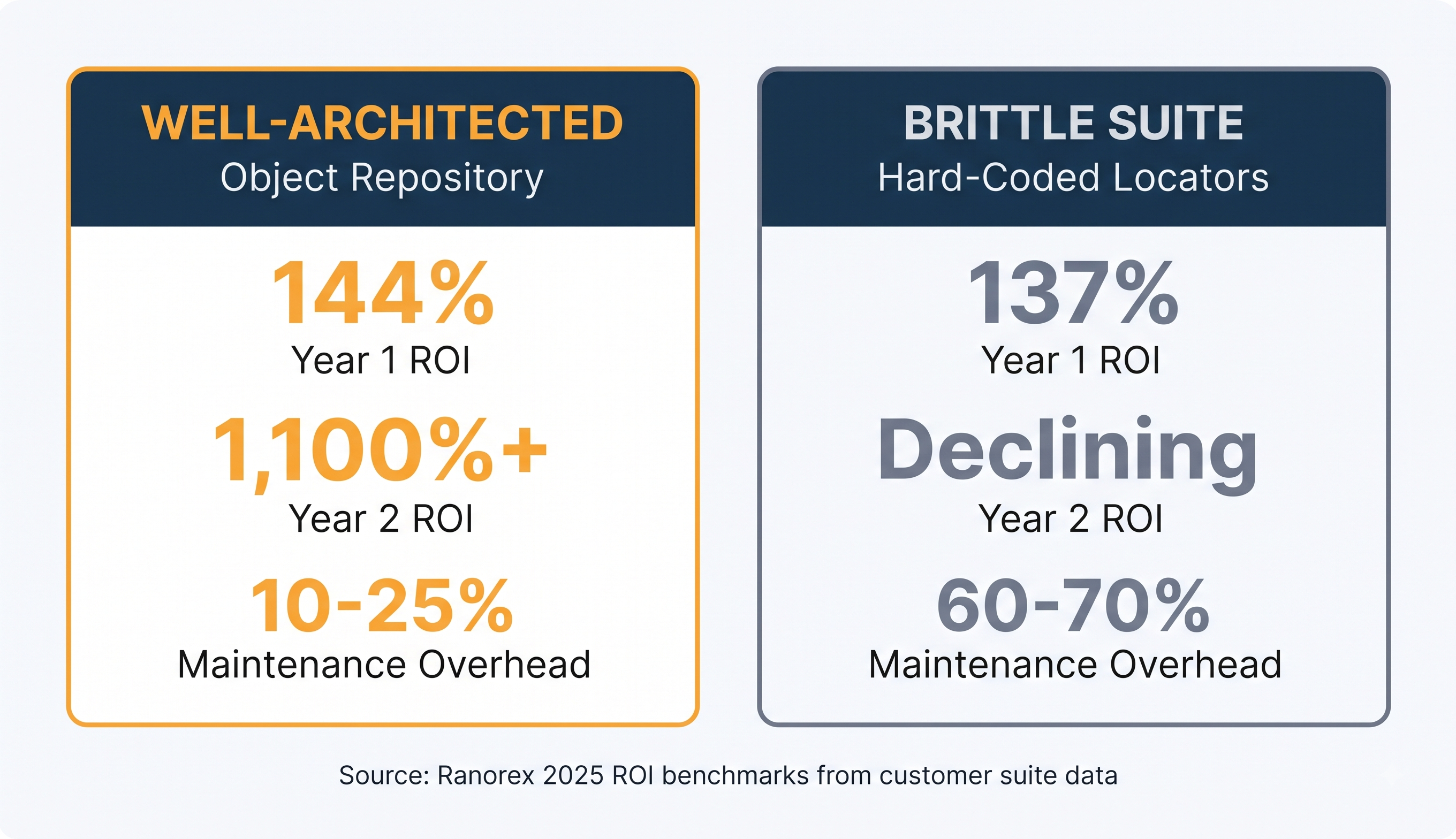
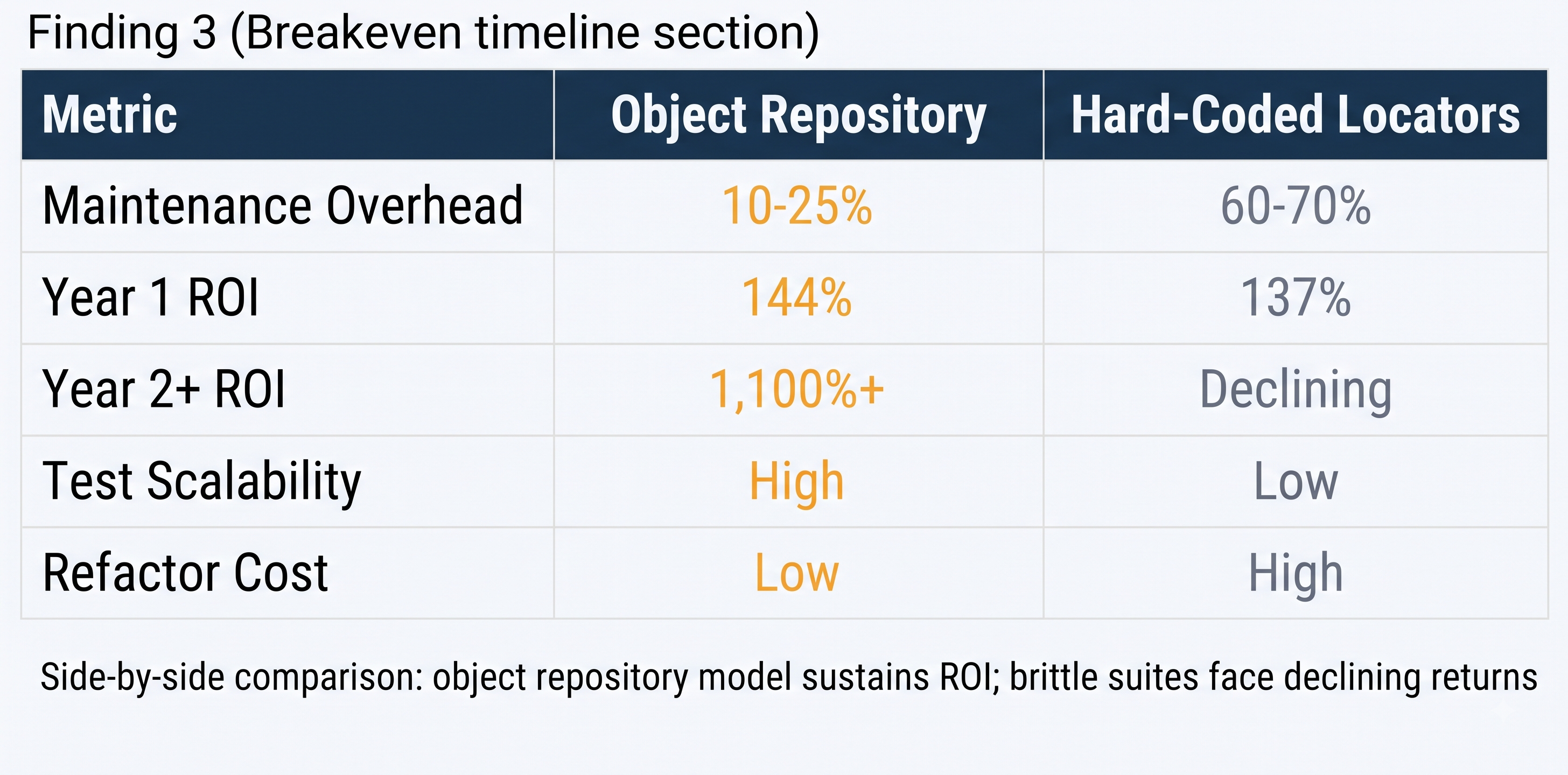
According to Ranorex benchmark data , teams with object repositories achieved 144% ROI in year one, climbing to 1,100%+ by year two. Teams with brittle locators hit 137% initially, then decline as maintenance overhead climbs to 60-70% of total effort.

I built a testing framework for a fintech company in 2018 that made this exact mistake. We shipped working tests in four weeks, and the team celebrated. By month three, the regression suite was harder to maintain than manually running the tests. It took 18 months to refactor the whole thing. The automation testing service didn’t fail. We failed at architecture. See how to design test automation frameworks properly for the architecture decisions that actually matter.
Why teams miss it: tool vendors pitch ROI based on test count and execution speed. They don’t talk about maintenance architecture because that’s your job, not theirs. By the time you realize the architecture is wrong, you’re 10,000 lines of brittle code deep.
Regression Testing is 82% of What Automation Services Actually Deliver (But Teams Plan Like It’s 20%)
Automation testing services are sold as if they cover everything. Functional testing, exploratory testing, performance testing, security testing. In reality, 82% of the value comes from automating regression testing—running the same test scenarios repeatedly to catch regressions in new code.
According to Katalon’s 2025 survey, 45% of QA teams have automated regression testing. It’s the lowest-hanging fruit and the highest-ROI category. Everything else (exploratory testing, security testing, performance testing) is harder to automate and delivers less consistent value.
Here’s the trap: teams pick an automation testing service expecting comprehensive coverage, then get surprised when the vendor focuses heavily on regression suite building. The vendor isn’t avoiding the other categories. They’re delivering where the ROI actually lives.
A financial services company I consulted with expected their automation testing service to handle security testing. Security testing requires human judgment, threat modeling, and active adversarial thinking. It’s 2% automation, 98% expertise. The vendor correctly said no. But the company had budgeted for it, and by the time they reallocated resources, three months were gone.
Why teams miss it: automation testing services are marketed as Swiss Army knives. The reality is they’re excellent regression testing tools and mediocre at everything else. Knowing that upfront saves you from mismatched expectations and wasted budget.
Breakeven is 3-6 Months Only If You Stop Building New Tests After Month Two
Automation testing services cite 3-6 month breakeven timelines. That stat is real, but it assumes you’re running tests, not continuously expanding coverage. The moment you commit to growing test coverage (which most teams do because automation makes that possible), your math changes.
According to Ranorex ROI data, breakeven happens fastest when you’re automating existing manual test suites. You run the same 200 tests. They execute in one-tenth the time. ROI delta is immediate. But if you’re building new tests every sprint, you’re also building new maintenance debt every sprint. The ROI timeline stretches.
According to Ranorex research, only 25% of companies report immediate ROI from automation testing services. The rest hit breakeven after several months because they underestimated either the upfront architecture work or the ongoing maintenance load.
A SaaS company automated 80 test cases in their first phase. Breakeven came at month 4, exactly as the vendor promised. Then they decided to grow to 500 test cases. Each new test added maintenance load. They hit 500 cases by month 18, but the time saved per release cycle was half of what they’d projected because the maintenance overhead had climbed.
Why teams miss it: ROI calculators are based on static test counts. Real-world automation grows because teams finally have time to expand coverage. That growth looks like a win, but it resets your maintenance math.
61% of Teams Express Interest in AI-Driven Testing Services But Only 35% Are Using It Meaningfully
This is the momentum wedge right now. AI-powered automation testing services are the newest pitch, and the interest is high. According to Katalon’s 2025 QA report, 61% of QA teams believe AI-driven testing will be important in the next 3-5 years. But according to Katalon data, only 35% report meaningful current usage for test optimization.
That gap tells you something important: people want AI-driven services, but they’re not ready for them yet. Either their frameworks aren’t structured properly (which makes AI optimization impossible), or they’re still focused on covering the basics with deterministic testing.
If you’re evaluating automation testing services right now and the pitch is heavy on AI, make sure your foundation is solid first. AI optimization runs on top of well-architected test suites. If you’re still building brittle locators and fighting maintenance, AI won’t fix that. It’ll just give you faster failures. Read how AI impacts QA testing strategies to understand what actually needs to be in place first.
Why teams miss it: AI is the trendy pitch. It sounds like it solves problems it can’t actually solve. A well-architected, AI-enabled suite is powerful. A brittle suite with AI on top is just faster waste.
43% of Teams Release Weekly or More But 59% Aren’t Prepared for QualityOps
Here’s the reality disconnect: faster release cadence puts pressure on automation testing services to keep up. If you’re releasing weekly, your regression suite has to run completely and report results within hours, not days. Most automation testing services can do that technically. Most teams can’t manage the process side of it.
QualityOps is the orchestration layer that makes automation testing services viable at high release velocity. It’s not a tool, it’s a discipline: integrating test execution into every CI/CD pipeline stage, automating result analysis, and gating deployments on quality metrics. Without it, your automation testing service just creates noise in your pipeline.
According to Katalon’s 2025 data, 59% of teams aren’t prepared for QualityOps. They want the speed of weekly releases and the rigor of automated testing, but they haven’t built the operational structure that makes both possible simultaneously. The automation testing service fails because the ops didn’t scale with it.
A B2B software company pushed for weekly releases but never built QualityOps discipline. Their automation testing service was technically solid, but they couldn’t interpret the results fast enough to matter. The pipeline was doing 50 test runs a week and reporting via email summaries that arrived too late to act on.
Why teams miss it: automation testing services are positioned as point solutions. You pick a tool, hire a vendor, ship tests. The reality is they’re part of a system that includes CI/CD integration, result interpretation, and risk-based gating. Learn how to build continuous testing pipelines (https://testmetry.com/continuous-testing-pipeline/) for the operational structure that actually works.
Stuff That Doesn’t Work
Three things teams do with automation testing services that consistently fail:
First, building comprehensive test coverage from day one. Teams overestimate how much they can automate initially and end up with bloated suites that are hard to maintain. Start with the 20% of tests that catch 80% of defects. Build from there.
Second, treating automation testing services as a testing service instead of a quality strategy shift. You’re not just automating tests. You’re restructuring how your team thinks about verification. If the mindset doesn’t shift, the tool doesn’t deliver.
Third (and I’ve made this mistake myself), treating manual testing and automation as competitors. They’re not. Manual testing is irreplaceable for exploratory work, edge cases, and context-dependent scenarios. Automation handles regression. Both matter. Most automation testing services can do both well, but only if you’re clear about which one to use for what.
How This Changes What You Do
Three moves to make this work:
First, before you evaluate a single automation testing service vendor, nail your architecture. Object repository, centralized locators, modular test structure. This is non-negotiable. It’s boring. It’s not the exciting part of the pitch. It’s 80% of your ROI.
Second, be honest about what you want automated. Probably regression testing. Maybe a subset of integration testing. Not exploratory testing. Not security testing. Not performance testing (usually). Know that upfront and don’t let a vendor oversell you on capability breadth.
Third, plan for the ops side. If you’re releasing weekly, your automation testing service has to fit into a QualityOps structure. That means test result automation, pipeline gating, and risk-based prioritization. Build that infrastructure before you’re drowning in test data.
FAQ
What is the average ROI of automation testing services?
According to Ranorex, well-architected automation testing services achieve 144% ROI in year one, climbing to 1,100%+ by year two. Brittle suites hit 137% initially then decline as maintenance overhead climbs to 60-70% of effort. The architecture matters more than the average.
How long does it take to see ROI from automation testing services?
According to Ranorex data, breakeven typically arrives in 3-6 months if you’re automating existing manual tests at a steady rate. If you’re continuously adding new test coverage, the timeline extends because each new test adds maintenance debt. Only 25% of companies report immediate ROI.
Should we hire an automation testing service or build in-house?
Both work if the architecture is right. Hiring a service gives you domain expertise and faster ramp-up but less control over framework decisions. Building in-house gives you control but requires hiring and training. The bottleneck is the same either way: architecture decisions made early determine success.
Does automation testing service replace manual testing?
No. Automation testing services excel at regression testing (running the same tests repeatedly to catch regressions). Manual testing is irreplaceable for exploratory work, edge cases, and complex scenarios. Both are necessary, and both should be part of your strategy.
What’s the difference between automation testing services and continuous testing?
Automation testing services are the individual test scripts and framework. Continuous testing is the integration of those scripts into your CI/CD pipeline so they run automatically with every code change. Continuous testing is the operational layer that makes automation testing services viable at speed.
How do I choose between automation testing service vendors?
Evaluate them on three things: framework architecture capability (do they enforce object repositories?), CI/CD integration depth (can they run tests at every pipeline stage?), and QualityOps maturity (can they help you interpret results and gate deployments?). Tool choice is the third priority, not the first.
What frameworks do automation testing services typically use?
Selenium, Playwright, and Cypress for web testing. Appium for mobile. Postman and REST Assured for API testing. The choice is less important than how they’re architected. A brittle Selenium suite is worse than a well-architected Playwright suite.
Bigger Picture
Automation testing services are reshaping how quality gets built into software. The industry is shifting from testing-as-afterthought to testing-as-architecture. That shift is real and irreversible. Release velocity demands it.
What’s changing in the next two years: AI-powered test optimization will matter more. Teams will move from static test suites to adaptive ones that learn from failure patterns and optimize coverage dynamically. But that only works on well-architected suites. It’ll deepen the gap between teams that got the foundation right and teams that didn’t.
The other shift: QualityOps becomes a dedicated discipline. You’ll see more teams hire QualityOps engineers specifically to orchestrate testing, integrate results into pipelines, and gate deployments on quality. The automation testing service is the tool. QualityOps is the skill. Both are necessary.
Closing
You don’t pick an automation testing service and hope it works. You make architecture decisions upfront that determine whether it will. Object repositories instead of hard-coded locators. Regression focus instead of everything-at-once. Ops discipline instead of tool optimization.
Sources
- Ranorex 2025 Test Automation ROI Benchmarks: https://www.ranorex.com/blog/test-automation-roi/
- Katalon 2025 QA Industry Report: https://katalon.com/resources-center/blog/test-automation-statistics-for-2025