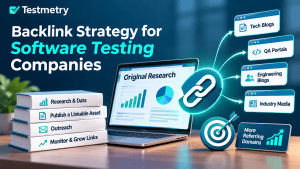
Software testing is a crowded content category. QA agencies, test automation vendors, test management platforms, and crowdtesting networks all publish the same “top 10 testing trends” posts, and almost none of them earn links. Editors, engineering leads, and technical bloggers have little reason to cite a recycled listicle. They have an excellent reason to cite a fresh data point.
That is why original research is the most reliable backlink strategy for testing companies. A well-designed survey, benchmark, or defect dataset gives other writers something they cannot get elsewhere: a number they can quote, a chart they can embed, and a finding they can argue with. Each of those turns into a referring domain.
This guide walks through the full process: choosing a research question, collecting defensible data, packaging it as a linkable asset, building a prospect list, running outreach, and monitoring the links you earn. It also covers the five outreach email tools that make the distribution step manageable.
Table of Contents
ToggleWhy Original Research Earns Links When Other Content Doesn’t
A backlink is a citation. People cite sources that add something to their argument, and in a technical niche like quality assurance, the most useful thing a source can add is evidence.
Original research works for link building for several reasons:
- It is scarce. Few companies publish proprietary data about defect rates, automation coverage, release cadence or test maintenance costs. Scarcity creates citation demand.
- It is quotable. A statistic such as “X% of teams report flaky tests as their top automation blocker” can be lifted straight into an article, a conference talk or a LinkedIn post, usually with attribution.
- It supports E-E-A-T. Search engines look for experience, expertise, authoritativeness and trust. First-hand data from a company that tests software for a living is direct evidence of all four.
- It compounds. A strong study keeps attracting links for months because new articles on the same topic reference it as the standard source.
- It earns links from different site types. Developer blogs, engineering newsletters, industry publications, analyst roundups, university course pages and tool comparison sites can all cite the same report.
Compare that with a generic how-to post. It may rank, but it rarely gets cited, because a dozen similar posts already exist.
What Counts as Original Research in Software Testing
Original research doesn’t require a research lab or a six-figure budget. It needs a question, a method, and an honest write-up. These are the formats testing companies use most often.
Industry surveys
Survey QA engineers, SDETs, test managers, and engineering leaders about practices, tooling, and challenges. Topics such as automation adoption, AI-assisted test generation, shift-left and shift-right adoption, and test environment bottlenecks all work well. Survey reports tend to earn the widest range of links because they speak to a whole profession.
Aggregated, anonymized product or service data
If your platform runs test executions, your agency logs defects, or your tool tracks test cases, you hold data nobody else has. Anonymized and aggregated, it can show things like average test suite runtime, flaky test rates, defect escape rate by release type, or the distribution of failures across browsers and devices.
Benchmark studies
Benchmark a set of tools, frameworks, or approaches under controlled conditions. Examples include comparing end-to-end test execution times or measuring how much time teams spend maintaining brittle selectors versus writing new tests. Publish the methodology so others can reproduce it.
Public data analysis
Analyze open data. Examples include public issue trackers, open-source CI logs, public postmortems, and app store reviews. Mining the bug reports of popular open-source projects, for instance, can reveal where defects cluster and how long they take to fix.
Expert panels and roundups with a data layer
A panel of respected testers is useful, but a panel that also answers the same structured questions is better, because you can aggregate the answers into findings.
Year-over-year trackers
A “State of Testing” report published annually becomes a reference asset. Journalists and bloggers return to it, and each new edition refreshes the links pointing to the series.
Step 1: Choose a Research Question People Already Care About
The best research questions sit where your expertise meets an active debate. Before collecting any data, check three things:
- Is there a live argument? Topics such as manual versus automated testing, the real cost of flaky tests, whether AI will replace test engineers, and how much testing belongs in production are being discussed constantly. Data lets you settle part of the argument.
- Does the data not exist yet? Search for existing reports. If five already cover the same question, find an underexplored angle, a niche segment, or a more recent time frame.
- Can the result be summarized in one sentence? If you cannot state the headline finding simply, writers will struggle to cite it.
Sample research questions that fit software testing companies:
- How much engineering time do teams spend maintaining automated tests compared with writing new ones?
- Which types of defects most often escape to production, and which test layers could have caught them?
- How has adoption of AI in test generation and test maintenance changed over the past year?
- How do teams that practice shift-right testing, such as canary releases, feature flags, and production monitoring, compare on incident recovery time?
- What is the real flaky test rate across public CI pipelines?
Google’s own engineers show how far a single dataset can travel. A Google Testing Blog post on flaky tests reported that about 1.5% of all test runs at Google were flaky and that almost 16% of its tests had some level of flakiness. Specific, sourced numbers from real production data are exactly what other writers keep citing.
A small caveat: avoid questions where the honest answer might embarrass you. Credible research includes findings that do not flatter the sponsor, and editors notice when a study is rigged to sell a product.
Step 2: Collect Data You Can Defend
Backlinks follow credibility. If the methodology is weak, a skeptical editor, or a quick reply on social media, it will dismantle the study and your outreach along with it.
Follow these basics:
- Define the population. Who exactly are you surveying or analyzing: QA engineers at companies with 50 to 500 employees, or maintainers of open-source JavaScript projects? Say so.
- State the sample size and collection dates. Even a modest sample is acceptable if you are transparent about it and avoid overgeneralizing.
- Reduce bias. Do not survey only your customers or mailing list if you plan to make claims about “the industry.” Recruit through neutral channels such as testing communities, conference attendees, and professional networks, and disclose the channels.
- Document the method. Add a short methodology section covering question wording, tools, filters, and any data cleaning.
- Separate findings from opinion. Present the data first. Put commentary in a clearly labeled section.
- Protect privacy. Anonymize and aggregate product data, and obtain internal sign-off before publishing anything derived from customer activity.
A straightforward, well-documented study beats a flashy, opaque one every time.
Step 3: Package the Research as a Linkable Asset
The data is the raw material. The linkable asset is how you present it so that people can use it.
A strong research page includes:
- A clear headline finding at the top, with the main statistic in the title or first paragraph.
- A key findings summary of five to seven bullet points writers can scan in seconds.
- Original charts and graphics with a visible embed option or download link. Charts that are easy to reuse get cited more often.
- A methodology section, as described above.
- Analysts and bloggers: can run their own cuts using a downloadable report or dataset, such as a PDF or CSV.
- Quotable pull statements that can be used independently, since writers often copy them directly.
- Expert commentary from named testers or engineers, which adds a human voice and supports E-E-A-T.
- A stable, descriptive URL that you intend to keep and update, rather than replace.
Technical structure matters too. Use a clean heading hierarchy and descriptive alt text on charts, add an article schema to the page, and consider Dataset structured data if you publish the underlying data. Google uses dataset markup for dataset search rather than standard search results, so treat it as an extra for discoverability, not a ranking lever. Also include a short “How to cite this research” line with a suggested attribution. It removes friction for writers and makes the link more likely.
BuzzStream’s analysis of 624 Talker Research surveys is a useful reference for what separates survey-led campaigns that earn links from those that do not.
Step 4: Build a Prospect List of Likely Linkers
A great report with no distribution is a quiet page. Linkers are not random; they fall into predictable groups.
- Software testing blogs and publications that regularly cover trends, tooling, and practices.
- Engineering and DevOps newsletters whose editors curate links for developers.
- Tech and trade journalists who cover software quality, outages, or developer tools.
- Authors of existing roundups who already cite competing or older statistics on your topic. These pages are prime targets because they need current numbers.
- Conference organizers and speakers looking for data to support talks on QA and test automation.
- Educators and training providers who maintain reading lists for testing certifications and courses.
- Tool comparison and directory sites that reference market data.
A practical shortcut: search for the statistics your research updates or contradicts. Every page quoting an outdated or weaker number is a ready-made pitch, because you can offer a more recent source.
Two more prospect sources are worth checking. Conference organizers publish speaker lineups and resource pages, and Testmetry’s directory of software testing conferences is a handy place to start. For journalists, BuzzStream’s podcast episode on what tech journalists actually want from PR is useful listening before you write a single pitch. To build and organize the list itself, tools such as BuzzStream’s ListIQ are designed for media list building.
Track every prospect with contact details, the page you want to be cited on, the reason it fits, and the status of your conversation. A spreadsheet works for a handful of contacts, but it breaks down once you run dozens of conversations in parallel, which leads to the tooling question.
Step 5: Run Outreach with the Right Email Tool
Outreach is where most research campaigns succeed or stall. You will send personalized emails to many people, follow up politely, keep track of replies, and avoid pitching the same editor twice. The right outreach platform handles contact discovery, templating, sequencing, and relationship tracking so you can spend your time on the pitch itself.
Here are five outreach email tools worth evaluating for a research-driven link-building campaign.
Top 5 Outreach Email Tools for Link Building and Digital PR
- BuzzStream is purpose-built for link building and digital PR teams. It combines prospect discovery, contact research, email templates, follow-up sequences, and a relationship CRM in one place, so you can see every conversation with every editor and blogger without digging through inboxes. Team collaboration features help prevent duplicate pitches, and link monitoring helps you confirm that earned links stay live. For a research campaign that involves dozens of prospects and multiple follow-ups, this end-to-end view is the main advantage.
- PinkPost.io is a newer outreach platform that helps marketers organize pitching and follow-ups for content promotion campaigns. It suits teams that want a lighter, more focused workflow for sending outreach emails and tracking responses without a heavy setup process.
- Respona focuses on AI-assisted personalization at scale. It helps you find prospects, pull relevant details from their pages, and build sequences, which is useful when a campaign targets hundreds of contacts and each email needs a custom opening line.
- Pitchbox is geared toward larger SEO and agency teams. It offers prospecting, outreach automation, reporting, and team workflows and is typically considered by organizations running link building programs across multiple clients or markets.
- Lemlist is a cold email platform known for personalization features and multichannel sequences. It is built more broadly for sales outreach than for link building specifically, but it works for teams that want strong deliverability tools and flexible sequencing.
How to choose: Match the tool to your campaign size and workflow. If you are running a focused research promotion with a team and want one system for prospects, emails and relationships, a link-building-specific CRM is usually the best fit. If your priority is raw volume and personalization, an AI-assisted tool may serve you better. In every case, check deliverability controls, sending limits and how each platform handles opt-outs, because respecting recipients protects your domain reputation.
To see how a purpose-built platform supports this workflow, explore BuzzStream’s link building and public relations pages.
Step 6: Write a Pitch That Leads with the Finding
Editors receive far more pitches than they can read. A research pitch succeeds when it opens with the insight and makes the next step easy.
Before you send anything, test whether your angle is newsworthy with BuzzStream’s V.E.T. framework, and brush up on email outreach basics and ways to increase email open rates. Deliverability matters just as much, so make sure SPF, DKIM and DMARC are set up on your sending domain.
A reliable structure:
- Subject line: Lead with the data, for example, “New data: how much time QA teams spend maintaining tests.”
- Personalized opening: One specific sentence showing you read their work, ideally referencing the exact article where your data fits.
- The finding: One or two sentences stating the headline result.
- The value to them: Explain where the data could support or update their piece.
- The ask: A simple request, such as “Happy to share the full dataset or a custom chart if useful.”
- Easy access: Link to the research page and mention that charts and methodology are available.
Example:
Hi Priya, I enjoyed your piece on reducing flaky tests in CI pipelines. We just published a study of 2,000 anonymized test runs that shows where flakiness concentrates by test type. Your section on root causes might benefit from the numbers. I would be glad to send the underlying chart if you find it useful.
The example data is illustrative, so please replace it with your actual findings. Keep it short, avoid hype, and never overstate what the data shows.
Step 7: Follow Up, Add Value, and Monitor Links
Most links come from the follow-up, not the first email. People are busy, and a polite nudge a few days later often succeeds where the first message was missed.
- Schedule two or three follow-ups spaced several days apart, each adding something new, such as a different chart, a fresh angle, or a relevant quote from your expert.
- Offer exclusivity carefully. Giving a journalist early access or an exclusive cut of the data can secure a feature, but only offer it if you can honor it.
- Reply quickly when someone asks for the dataset, a quote, or a custom graphic.
- Thank people who link, and keep the relationship warm. A writer who cited you once is likely to cite your next study.
- Monitor your links. Track which pages link to your research, confirm the link attributes and anchor text, and watch for links that disappear. If a link breaks or is removed, a short friendly message often fixes it.
This ongoing monitoring mirrors the shift-right mindset in testing: release is not the end, and quality has to be verified in production. A published link is the same.
Common Mistakes to Avoid
- Publishing data with no methodology. Without it, careful writers will not cite you.
- Surveying only your customers and presenting it as an industry view.
- Burying the headline. If the key finding takes three scrolls to find, no one will quote it.
- Gating the whole report. A form wall reduces citations. Keep the key findings public and gate only extras if you need leads.
- Mass-blasting generic emails. Untargeted pitches damage sender reputation and burn good prospects.
- Letting the research go stale. Please update the page and consider repeating the study annually.
- Ignoring non-link wins. Mentions, social shares, and conference citations build authority and often lead to links later.
Measuring What Matters
A research campaign should be judged on more than the raw count of backlinks.
- Referring domains earned from relevant, authoritative sites.
- Link quality and relevance, meaning topical fit with software testing, QA, DevOps, and engineering.
- Organic visibility for the topic cluster the research supports.
- Referral traffic and downstream signups or demo requests.
- Brand mentions and citations, including in AI-generated answers and industry roundups, which increasingly pull from well-cited original data.
- Outreach conversion rate, meaning the share of prospects who reply and the share who link, so you can improve each campaign.
Frequently Asked Questions
How large does a survey need to be to earn links? There is no universal threshold. A few hundred qualified respondents from a clearly defined group is often enough, as long as you are transparent and do not overgeneralize.
Do we need to publish a full report, or is a blog post enough? A dedicated research page with key findings, charts, and methodology is usually enough. A downloadable PDF is a useful extra for analysts and journalists.
How long does it take to see links? Some links arrive within days of outreach, while others accumulate over months as more writers discover the study. Plan for a campaign window of several weeks, then continue selective promotion.
Can small testing companies compete with large vendors on research? Yes. A narrow, well-executed study on a niche topic, such as test maintenance in mobile apps, can outperform a broad but shallow report from a larger competitor.
Should every study include a product pitch? No. Keep the research neutral and place any product mentions in a clearly separate section. Credibility is what earns the link.
Conclusion
For software testing companies, original research is the most dependable way to earn backlinks that carry real authority. It turns your day-to-day expertise into evidence, evidence into citations, and citations into lasting visibility.
The process is repeatable: pick a question the community cares about, collect data you can defend, package it as a genuinely useful asset, build a targeted prospect list, run personalized outreach, and keep monitoring what you earn. With the right workflow and the right outreach tooling, a single well-made study can keep working for your brand for years.